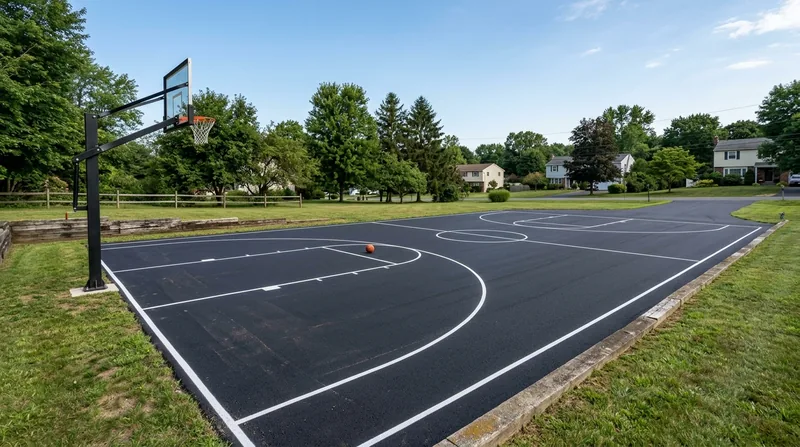




A sports court and path paving project in Albany demands more than hot mix asphalt laid flat. The Hudson Valley's freeze-thaw cycle, heavy clay soils west of the river, and the region's wet springs create conditions that test both drainage and base stability. Whether you are building a basketball court on a sloped lot in Guilderland, a tennis surface in Troy, or a walking path through a neighborhood in Schenectady, the foundation determines how long the court holds up and plays true. We grade for runoff, set proper slope, and lay asphalt that stands up to daily use and seasonal stress. The work is straightforward, but the site preparation separates a court that lasts from one that cracks and heaves within a few years.
Why Sports Court and Path Paving Matters in Albany's Climate
Albany's winters drive frost roughly 42 inches into the ground, and that cycle of freeze and thaw works on any surface that sits above clay and poor drainage. A sports court built without proper base preparation will heave unevenly, creating soft spots where the ball bounces unpredictably and cracks that open each spring. The problem is not the asphalt itself, but what lies beneath it. Paths that cross low spots or run through areas where water pools will fail faster than those with clear drainage. We prepare the base by grading the lot to shed water away from the court, compacting the subgrade, and laying stone base so that frost heave and water saturation do not undermine the playing surface.
- A level, well-drained base prevents the soft spots and heaves that develop under freeze-thaw stress.
- Proper slope keeps meltwater and rain from pooling at the edges or under the court, where it breaks down the asphalt and base.
- Hot mix asphalt laid to the right thickness and compaction gives you a surface that holds up to daily play and seasonal weather.
- Early drainage planning saves thousands in repairs down the road, especially on the clay soils common in Albany and Latham.
A court that drains well and sits on a compacted base will outlast one that was simply paved over existing grade, no matter how good the asphalt looks on day one.
Key info: Many homeowners in Albany and Colonie discover too late that a basketball court or path paved without proper grading will develop cracks and soft spots by the second or third spring. The fix then is either patching (temporary) or tearing out and repaving the whole surface. Getting the base right the first time costs less than fixing it later.
For permit and drainage requirements in your area, check with your local city or village building department, as rules vary across Greater Albany and surrounding towns.
How We Build a Sports Court or Path: The Step-by-Step Process in Albany
Our approach starts with the ground and works up. We begin by visiting the site to understand the slope, drainage patterns, and soil conditions. On sloped lots common in Bethlehem and west of the river, we grade to direct water away from the court. On flatter sites in Troy or Schenectady, we may need to create a gentle crown or install drainage swales to keep water from sitting. Once the grade is set, we lay a stone base, compact it, and then pave the top layer of hot mix asphalt. The whole job is sized for the kind of play the court will see, so we use the right thickness and mix design.
- We visit the site and measure the area, assess slope and drainage, and identify any existing utilities or obstacles.
- We grade and compact the subgrade, removing soft or unstable soil and adding stone base as needed to create a stable platform.
- We lay hot mix asphalt to the thickness appropriate for the court type (tennis, basketball, or walking path) and intended use.
- We finish with a smooth, level surface that sheds water and provides the playing characteristics you need.
The grading step is where most of the value lives. A court paved over poor drainage or uncompacted ground will fail regardless of asphalt quality.
Local example: A family in Rensselaer wanted a basketball court on a lot that slopes toward the street. We graded the court to slope gently away from the house and toward a drainage swale, compacted the base, and laid 3 inches of hot mix. The court drains well, stays level during spring thaw, and has held up for years without cracking or soft spots. Without that grading, the same lot would have pooled water and failed within two seasons.
For a closer look at how we handle base preparation and drainage on other types of paving, see our page on gravel driveway installation and grading, which covers similar site-prep principles.
Sports Court and Path Paving Methods
| Approach | Description | Best for |
|---|---|---|
| Full-depth paving with site grading | We remove existing surface (if any), grade the subgrade, compact stone base, and lay new hot mix asphalt to finished thickness. | New courts, poor drainage, or sites where the existing grade is too high or too low. |
| Base preparation and paving only | We grade an already-cleared site, compact base, and lay asphalt without removing an existing surface. | New construction or sites where the subgrade is already stable and at the right elevation. |
| Overlay on existing court | We mill or scarify the existing surface to improve adhesion, then lay a new layer of hot mix asphalt. | Courts that are cracking or worn but have good base and drainage; extends life without full replacement. |
| Path paving with drainage | We grade a walking path to slope gently away from structures, compact base, and lay asphalt sized for foot traffic and light equipment. | Neighborhood paths, private roads, or connections between properties where drainage and durability matter. |
Sports Court and Path Paving Cost in Albany: What to Expect
A sports court or path paving project in Albany typically starts at $8,500 and moves upward based on site size, existing conditions, and the amount of grading required. A small basketball court on a well-drained lot with minimal prep might fall near the lower end. A larger tennis court on a sloped lot that needs significant grading, stone base, and drainage work will cost more. The biggest cost drivers are the size of the area, the depth of site preparation, and whether you need to remove an existing surface or bring in fill material to raise the grade.
Getting 2 or 3 estimates from local contractors is smart practice. Each estimate should include the thickness of asphalt, the amount and type of base material, and a clear breakdown of grading and drainage work. Avoid any estimate that simply quotes a price per square foot without specifying thickness and base prep, because that usually means the contractor has not looked closely at the site.
For a detailed pricing overview and to see how other services compare, visit our full pricing page. Every job is different, and the best way to know what your court or path will cost is to contact us for a free estimate.
Sports Court and Path Paving Near Me: What Albany Homeowners Should Know When Hiring
Hiring a paving contractor for a sports court or path is a decision worth taking seriously. The work is visible, long-lasting, and affects how the court plays and how long it lasts. Start by asking any contractor you interview to show you examples of courts or paths they have built, and ask for references from recent clients in your area, whether in Albany, Colonie, or Troy. A local contractor with a local address and local plates is a stronger signal of trustworthiness than one passing through with a truck from out of state.
Before you sign a contract, confirm that the contractor carries liability insurance and that their estimate includes a clear breakdown of site prep, base material, and asphalt thickness. Ask whether your local building department requires a permit for the work. Some municipalities have rules about impervious surface limits or stormwater management that affect how a court must be drained. If your property is in an HOA, check the architectural standards, because some communities have rules about what surfaces are allowed or how they must be finished. Finally, verify that the contractor has located utilities with New York 811 before any excavation begins, because hitting a gas, electric, or water line is dangerous and expensive.
For more information and to get started with a free estimate, reach out to us here. We have been serving Albany and the surrounding region since 2016, and we are happy to answer your questions and walk you through the process.
Sports Court & Path Paving in Albany: Pricing Guide
| Service | Price | Details |
|---|---|---|
| Small basketball court or path (under 1,500 sq ft) | Starting at $8,500 | Includes site grading, stone base, and 3-inch hot mix asphalt on well-drained sites with minimal prep work required. |
| Medium court or path (1,500 to 3,000 sq ft) | Starting at $14,000 | Covers grading, base prep, drainage swales if needed, and full-depth hot mix paving on sites with moderate slope or preparation needs. |
| Large court or complex site with extensive grading | On estimate | Needed when site has poor drainage, requires fill material, significant slope correction, or removal of existing surface before new paving. |
| Overlay on existing court (no base removal) | Starting at $5,500 | Milling or scarifying the existing surface and laying a new 2-inch asphalt layer when base and drainage are already sound. |
| Free estimate and site visit | No charge | Response within 24 hours at (838) 217-7043, includes measurement, assessment of drainage and soil, and written quote with tonnage. |
Indicative pricing, the exact cost depends on square footage, finish, and site access. Free personalized estimate within 24h at (838) 217-7043.


